I’ve been an entrepreneur all my life, starting with paper routes in the 90s, mowing lawns in suburban Ohio, making (and unsuccessfully selling) greeting cards with my own photos, to (somewhat painful) MLM health and wellness products, launching an urban arts nonprofit organization, to launching my own web design company in its 10th year.
There’s been one common skill needed that I don’t naturally possess: managing a schedule. I supposed it could be in part due to my adult ADD that I’ve only just begun to understand and care for effectively (without drugs, thanks to Scattered Minds by Dr. Gabor Mate).
More than likely it’s simply due to what owner operator entrepreneurs have to learn and develop their own technique for – which is balancing the on/off switch in our heads.
The least talked about reality of entrepreneurship is the mental load and management of your own emotions and responsibilities. This “big secret” is difficult to admit to when the cultural messages are that ‘entrepreneurship is fun and exciting!’ and ‘grind your way to success!’ and ‘just lock in and get it done!’ These messages don’t honor the actual mental burdens or make it easy to be vulnerable when struggling with the associated behaviors.
When you are the one running the business, you wear a ton of hats and it’s easy to forget an appointment, overestimate your efficiency, or spend too much time doing something that really doesn’t matter in the big scheme of things.
Sound familiar?
There’s a solution I have created that will help you approach your schedule and responsibilities with a different mindset.
It’s not just a good idea – it’s vitally important for your personal and business health and success.
I call it the BLOCC Method.
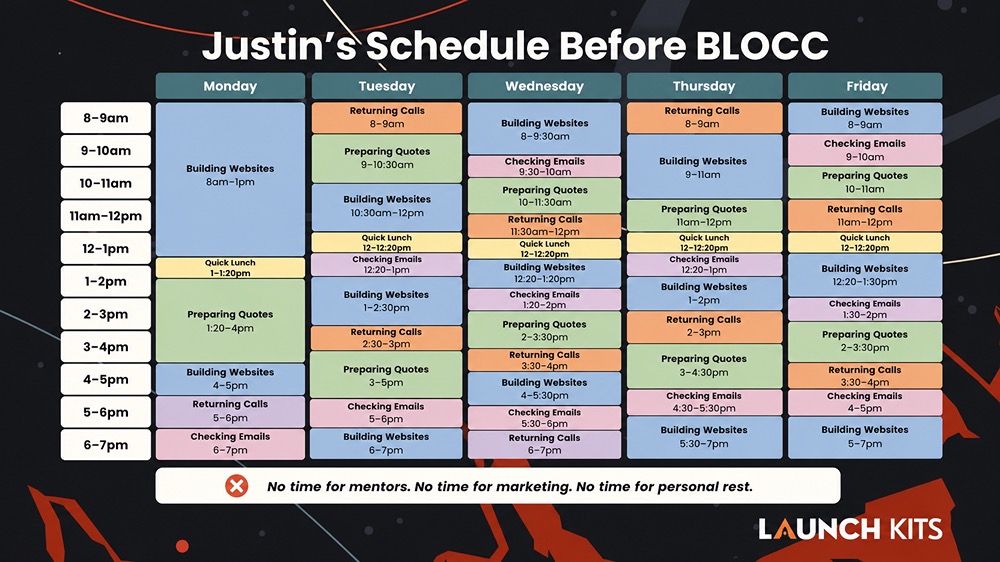
Introducing the BLOCC Method.
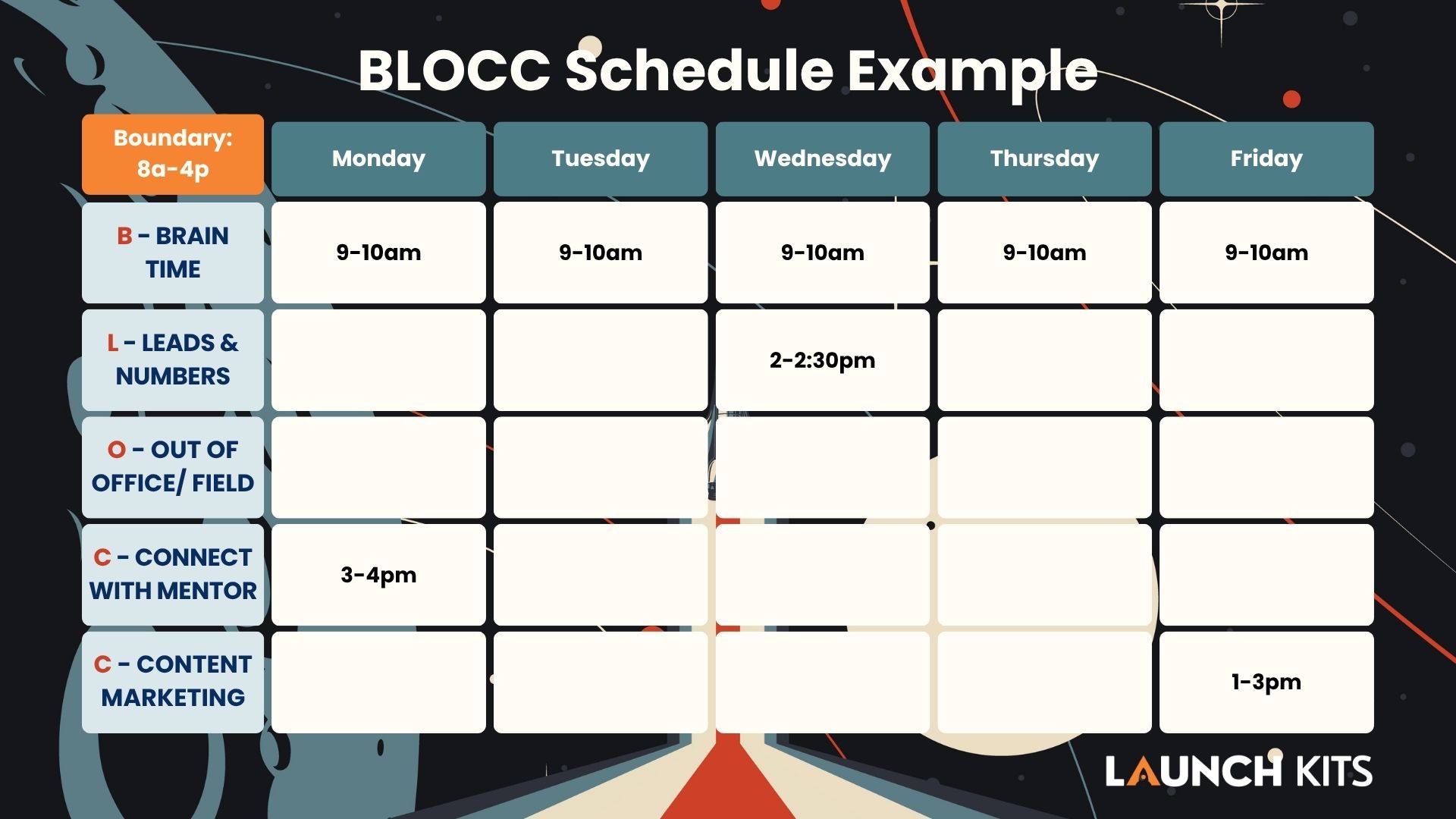
The B.L.O.C.C. Method is where you set a boundary for your working hours (a huge step for any entrepreneur, and not widely applauded) and then you use ‘blocks’ within your working hours to do the things necessary to build and sustain a profitable business and care for your own mental, physical, and spiritual well being. Some people may scoff at such an idea – that the business owners’ health is paramount to the success of a business.
Loud voices in the hustle culture and hack and startup circles have said that the reason entrepreneurs fail is because they don’t work harder than the next guy (ahhem, Mark Cuban).
But I disagree.
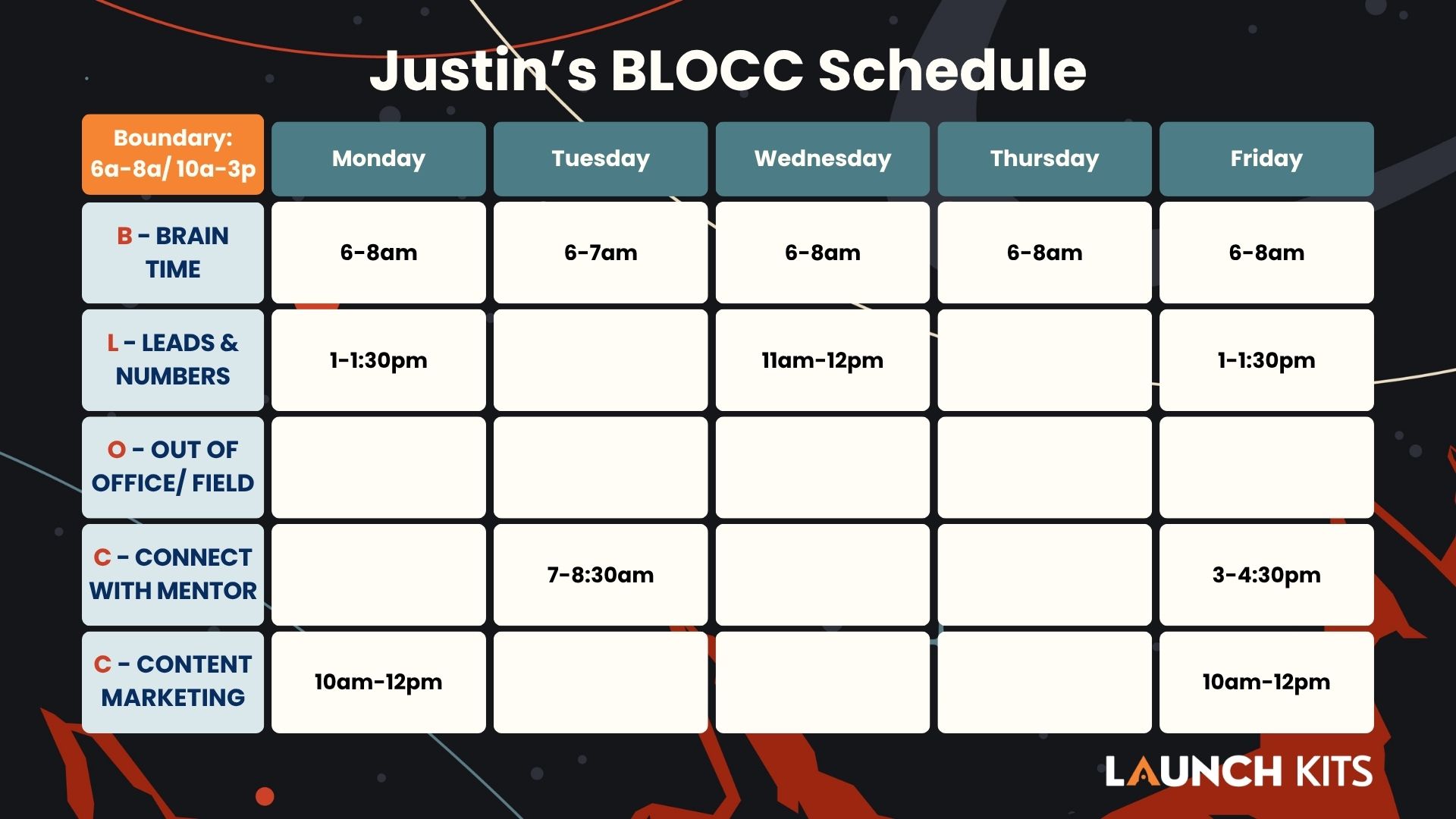
It’s not a lack of hard work. It’s doing the work that doesn’t work. So I came up with BLOCC’s to help me manage time and create boundaries. (You can see my actual BLOCC Schedule at the end of this article.)
BLOCC stands for Brain Time, Leads and Numbers, Out Of Office Time, Connecting with a Mentor, and Content Marketing. I’ll give you an outline of why I think this works best for entrepreneurs and how you can apply it, ready?
B – BRAIN Time
GOAL: 1+ Hours A Day
Within your allotted 40-hours of work you’ve set (because nobody starts a business to work 60 hours a week, so why let customer urgency or cultural pressure to steal your life), I suggest you set aside 1 hour a day for your “brain.” This includes anything that nourishes your mind, soul, spirit, and body and helps keep you in a place of healthy mental space as you run your business.
My Surf Rescue Technician Example (aka: beach lifeguard)
I was a lifeguard in Ocean City, Maryland for one long summer after I graduated college.
It seemed a good next step for my Oceanography degree.
I’m being serious.
I was privileged to save 68 people from drowning and have some amazing memories that summer (one of which was getting engaged!). In the Surf Rescue Academy, the instructors said “Whatever happens out there, you need to make sure you are able to swim back to shore: a drowning lifeguard can’t save anyone!”
We learned how to forcefully escape different situations where you’re being attacked in water, and it’s a good thing because it really happened hundreds of yards out in the ocean throughout the summer!

There are many ‘drowning’ business owners and voices out there trying to grab you and convince you to work longer, stay switched on all the time, and don’t miss your chance! But I can assure after over 30 years of entrepreneurship, if you don’t care for your own mind and soul and body, you won’t last long. Certainly your team won’t thrive under your leadership because you are drained and burned out, or hoping for a quick exit.
Please trust me, I have learned this lesson the hard way.
Your family will not like the person you become and no amount of ‘rewards from the business’ will compensate for an unstable and unkind spouse or parent.
What my BRAIN Time looks like:
I am unapologetically committed to spending no less than 1-hour each morning unplugged from my phone so I can journal, meditate, read books on personal development, pray, and read The Bible. It was not easy to train myself to not look at my phone as the first thing I did when I woke up. In fact, I won’t check messages, answer calls, or look at my to-do list on my phone until I have spent 1-2 hours nourishing my soul, sharpening my mind, doing some physical stretches, journaling and starting my day from a place of peace.
For me that means getting up at 6am and it’s become my favorite part of my day. If you asked me a few years ago about such an idea, I would have said “Sounds great, but I can’t do that.” However, over time, this habit is now nonnegotiable for me.
When can you fit in BRAIN Time as part of your working schedule as a business owner?
L – LEADS and Numbers
GOAL: 30+ Min A Week
Entrepreneurs tend to come out of the gate thinking that working in the business is what makes or breaks you. However, setting aside time just to look at your leads and crunch some key numbers every week is a healthy habit – especially when they come at you from every direction and easily rob your after-hours from being truly unplugged hours.
For many service based businesses, you can easily setup automatic response systems to respond to website lead forms, text messages, or even be clever about how you setup voicemail for your business (ask me for my best voice mail message ideas for service businesses!). So only blocking 30mins to an hour to get back to leads or look at numbers sounds crazy.
If you don’t know your numbers, you don’t know your business.
– Marcus Lemonis
Here’s what it means for your business: block at least 30 minutes on a specific day of the week to use your lead tracking system (whether it’s your inbox, a google spreadsheet, a CRM, or something simple like the CONNECTOR Dashboard) and to make sure you’ve responded to all active leads. Put this time on your calendar and treat it like a client meeting. Don’t miss it. Don’t be late.
I like to call this ‘having coffee with your numbers once a week.’
You can also look at key numbers like retention, sales averages, P&L reports, website traffic, or your pipeline revenue. When you are looking at this weekly, it feels less overwhelming and you get a sense of the flow and are in tune with your numbers. As business tycoon and small business genius Marcus Lemonis famously says, “If you don’t know your numbers, you don’t know your business.”
What my LEADS looks like:
I use the CONNECTOR Dashboard to manage what is in the pipeline and to respond to leads. So when I have my 30 minute coffee date with my numbers, I easily seek where we are at. I will typically hop into Google Analytics to see how the last 30 days has been going in terms of traffic, acquisition, landing pages etc and see if any of my recent efforts are causing spikes or making an impact in traffic or conversion.
I also have a team member who helps me make sense of the things I don’t understand which you can easily do as well (or use your C connection, more on that further on in this article, as a resource).
O – Out Of Office (aka ‘in the field’)
GOAL: 3+ Days A Week
Most service based business owners spend a ton of time in the field with customers, on job sites, doing the actual work. If you’re not careful in applying this very method of BLOCC Scheduling, you end up simply having a job instead of owning a business.
However, I realize that to ensure your quality of service is up to par and that customers feel the connection between the business owner and the services you provide (a unique feature and advantage for small businesses), it is indeed important to schedule time in the field.
The key here is to not spend all your time in the field. This O Element to the scheduling method is the time you do sales in person (note: I don’t suggest hiring a full time sales person), or work directly on a project on site, and you are keeping your ear to the ground about customer needs and expectations from first-hand experiences.
I am sure you are aware of the ‘owner envy’ that can creep in and ruin great workers when they don’t feel like their boss/owner is ever getting their hands dirty. In truth, there will be a season if you are successful at slowly growing a profitable business that is likely to put your best efforts into the management of the business (that’s why you started, right?), but in the first 5-10 years of your business, you will want to make sure you keep your skills sharp, watch trends first hand, listen to your customers, and lead by example to your employees.
We can cross the out-of-the field season when you get there. I’ve got some tips for that as well.
If you’re the owner of a painting company, you may use the O Time to do on-site estimates, show employees how you want staging or trim techniques done, and leading your leaders in the field. The same goes for the owner of a lawn care business or most home service business owners.
What my Out Of Office Time looks like:
I schedule my other blocks (B, L, C, and C) first and then let my O time work around those pillars. It helps me determine when I am available for client meetings, sales calls, or overseeing our current projects to ensure they are meeting our standards for web design and best practices for startups.
C – CONNECTING With A Mentor
GOAL: 1+ Hours A Week
This is easily overlooked in the world of entrepreneurs. What benefit could come from ‘not working’ and simply talking or spending time with other business owners?
The answer? You’ll save yourself a lot of wasted time and misplaced effort.
You should unapologetically spend at least 1 hour every week with a mentor or a trusted friend, coach or someone you find inspiring to help you keep the end in mind in focus. Because you are doing it each week, you may have one week where you meet with a friend for lunch, the next week it’s a colleague ahead of you in their business, while the next week it’s your pastor, and the fourth week it’s a coach.
The benefits to having people keep you accountable, focused, offering correction, council, wisdom, or just companionship is a proven ingredient to the success of businesses over the long haul. It’s not a one man show. And speaking of ‘man’, the research shows that men are the ones most terrible at this! We don’t naturally value vulnerability and so we avoid it at all costs because culture or our upbringing has shaped an idea that ‘emotional men are weak men.’
You don’t have to take my word for it, but that’s completely disproven and wrong.
When I read Brene Brown’s book, Daring Greatly, it was full of research that showed vulnerability is the hallmark of courage, not weakness. It builds resilience and is a key for effective leadership. Although its counter cultural, its essential to relearn how to connect as men and to practice by scheduling weekly Connection times in your work week.
There are many ‘drowning’ business owners and voices out there trying to grab you and convince you to work longer, stay switched on all the time, and don’t miss your chance!
What my CONNECTION looks like:
I have a standing meeting with a friend on Tuesday mornings where we connect about life, family, theology, and business with no specific agenda. I also meet with a consultant (and friend) Dwight at least once a month to talk through different obstacles and issues as fathers and husbands and business owners. My friend Peter owns his own business and we meet up once or twice a month to chat about balancing life, work, family, and to encourage each other as we seek to live as a disciple of Jesus in our spheres of influence.
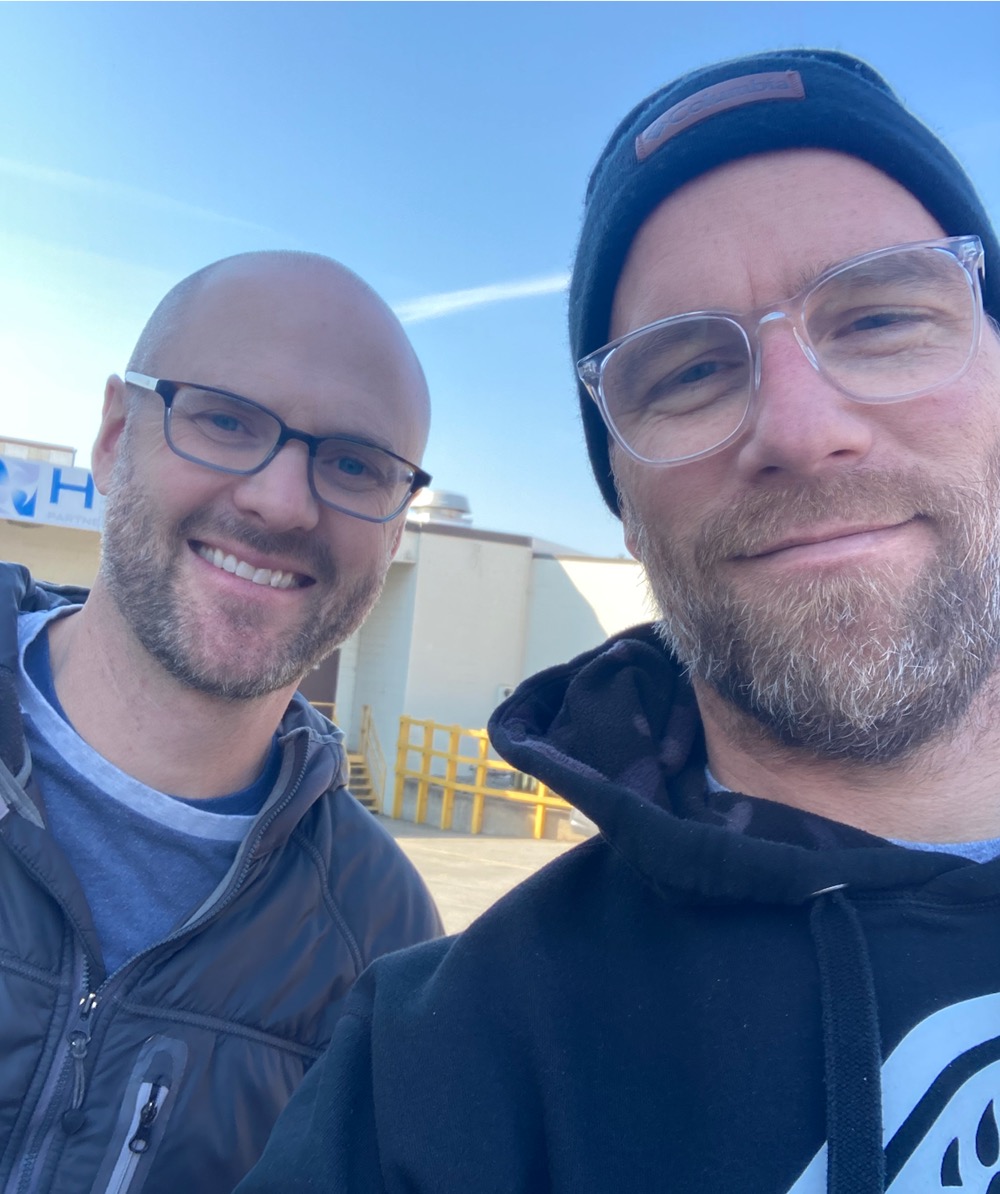
These connections to mentors have become key components to building the life I want to live. I believe relationships that are honest and consistently in my face will shape my heart to be more like the person I want to become.
C – CONTENT Marketing
GOAL: 2+ Hours A Week
This might seem scary, but it’s actually just a way for you to share your passion. The good news is you don’t have to hire a marketing agency if you do this right. I believe you can do it (and I have seen hundreds do it) on your own by scheduling 2-3 hours a week to use your own expertise to create blogs (like this!) or videos about your product or services to share with others.
As one well-known marketer said, “It’s not about making a perfect video; it’s about making the next helpful video.”
Readers and viewers value authentic content. The general rule is ‘share helpful content’ so people get answers to most common questions, understand that you are an expert, and see that you care. Sure, you can spend extra money and grab an online company or tool to ‘add extra features’ like animations, jump cuts, captions etc (I run mine thru Kapwing) but you can just hit ‘publish’ too.
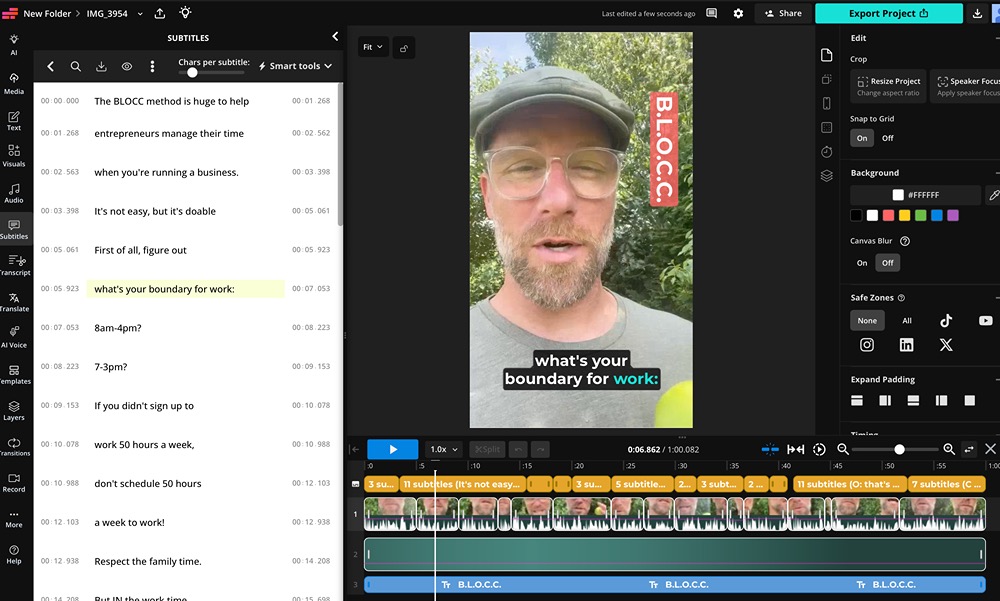
Well, more specifically: use your iphone to record either a short (less than 60 secs, vertical format) or a longer Q&A or tutorial video (3-5 minutes, landscape format). Then upload to your YouTube Channel with a clear Title. Boom. Done. Be consistent.
Love to write? Write your own answers and send to your web design team to post on your website as a blog. Or, take your transcription from your longer YouTube video and reword it and post it as a blog.
When you get in a rhythm each week, it becomes easier and easier.
What my CONTENT Marketing looks like:
I try to write 1 or 2 articles a month that answer common questions, address current issues, or share knowledge from my years running my own business. I find this fun, helpful in organizing my thoughts, and hear that others find it helpful too.
I also try to do a simple ‘short content’ YouTube video once a week in my 2-3 hour C block, and then challenge myself to post a longer one at least once a month to keep our brand in front of searchers on YouTube.
Why the BLOCC Method Works For Entrepreneurs
The BLOCC Method works because it makes time for all the things that I believe an owner operator should be doing to build a business, and not merely have another job. It organizes things into the right prioritization of time commitment and associated energy spent for the return of both slow growth profits over time, as well as maturity and mental health practices that sustain you for the long haul.
The other cool thing about this method is that if you find you need to do something that does not fit into one of the segments, then that tells you that you need a partnership with someone else (ex: a bookkeeper, an accountant) to do it.
Just because you are an owner and your vision is to have a small team doesn’t mean you have to get stuck doing all the things.
To Do or Not To Do?
My common assessment tool for ‘should I do this?’ to things that fall outside of the tasks I outlined above is dependent on how I answer both these questions: Does it give me joy and energize me? Can I hire/partner with someone to do it for less than $50/hour?
If it gives me joy, but I can hire someone for less than $50/hour, I will likely hire someone to do it and make sure my focus is on my key responsibilities. If I don’t like doing it, but I can’t find someone for less than $50/hour, I have a decision to make about whether it’s urgent or necessary, and then it make just be an expense with a reward of “not doing it myself.”
(I use $50/hour because that is $100k a year and likely a ballpark salary a small business owner would aspire to grow to earn for themselves… at least. So, if you are doing the task, it’s the same as paying yourself $50/hour as an expense against your business. If you can find someone to do it for less than that, you can save yourself the expense if you were the one tackling it. Make sense?)
The journey of entrepreneurship is finding out what works for you. If just some part of the BLOCC Method helps give you permission to schedule time for your own mental health and maturity, or to meet with a mentor consistently, or to take uninterrupted time to manage your leads (and to say no to checking your leads at all hours of the day), then I am glad the lessons I have learned the hard way may help you grow into a healthy small business owner with a profitable business that protects your family time.
Build a business you would want to purchase. Remodel your existing tasks and roles around a sustainable method that renews the passion and joy you once had when you embarked on your entrepreneurial journey.
The road to running a business in a healthy way is worth the work it will take to readjust and recenter.